Today
20
in History
26
January
February
March
April
May
June
July
August
September
October
November
December
01
Sun
02
Mon
03
Tue
04
Wed
05
Thu
06
Fri
07
Sat
08
Sun
09
Mon
10
Tue
11
Wed
12
Thu
13
Fri
14
Sat
15
Sun
16
Mon
17
Tue
18
Wed
19
Thu
20
Fri
21
Sat
22
Sun
23
Mon
24
Tue
25
Wed
26
Thu
27
Fri
28
Sat
...
02-16-1923
A Deadly Bite, Or King Tut's Revenge?
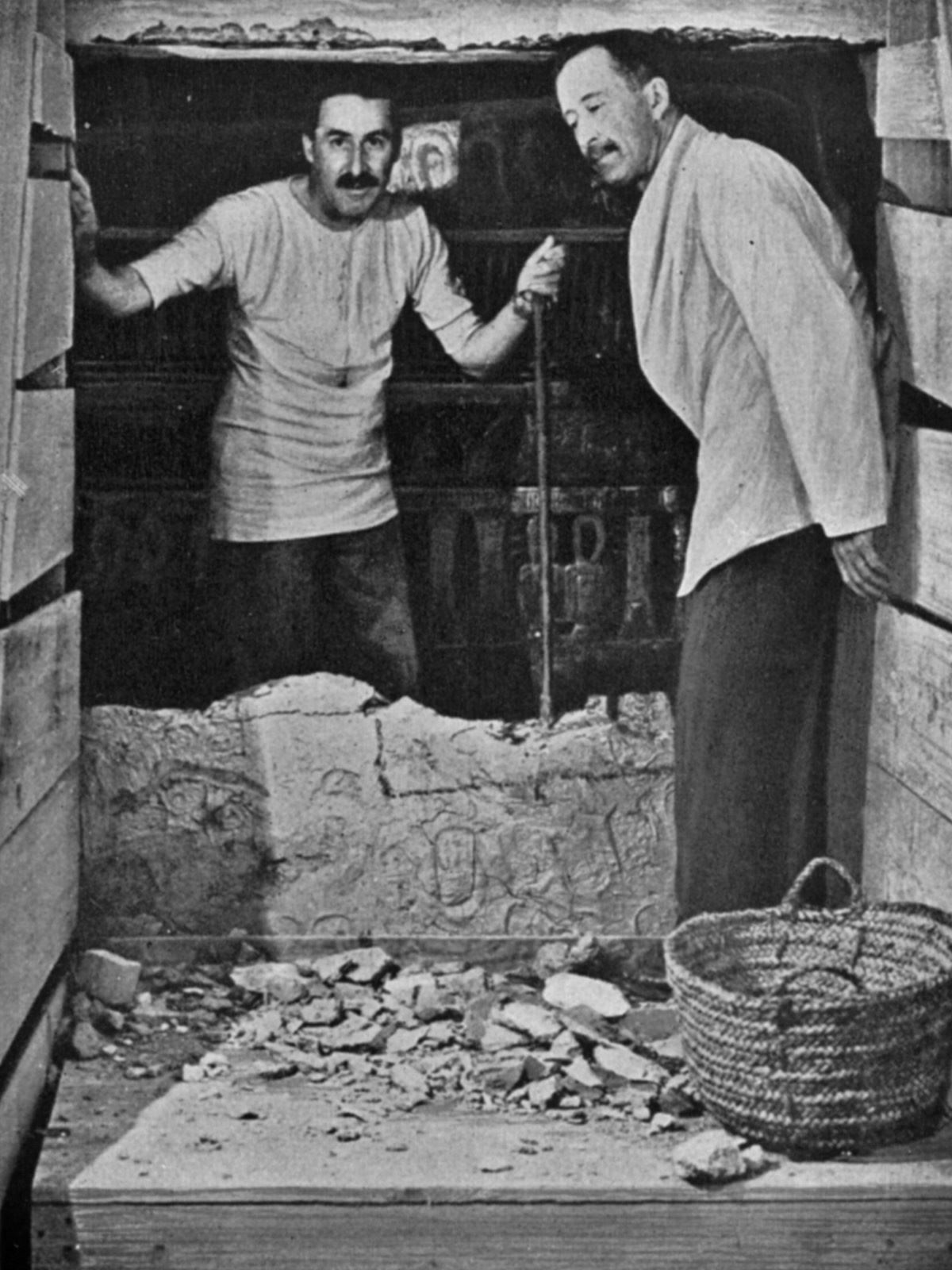
February 16, 1923 — It’s a discovery that would have made Indiana Jones envious: on this day archaeologist Howard Carter opened the sealed doorway leading to the burial chamber and sarcophagus of the Pharaoh Tutankhamun in Egypt’s Valley of the Kings.
A few weeks earlier, after making a "tiny breach” in the top left hand corner of the tomb doorway, he was asked by his patron Lord Carnarvon if he could see anything.
Carter replied: "Yes, wonderful things" and added: “As my eyes grew accustomed to the light, details of the room within emerged slowly from the mist: strange animals, statues, and gold – everywhere the glint of gold."
Some people believe that by opening the tomb, which had remained undisturbed for nearly 4,000 years, Carter unleashed the “Curse of the Pharaohs,” which is said to herald catastrophe for anyone who disturbs the mummy of an Ancient Egyptian person.
Certainly, some six weeks after Tutankhamun’s tomb was opened, Lord Carnarvon, who had paid for the expedition, was dead. He had been bitten on the cheek by a mosquito and made matters worse by shaving over the bite, causing an infection, blood poisoning, pneumonia and death.
At the time of Carnarvon’s demise in a Cairo hotel, the lights went out across the city and in England the earl’s saluki pet dog, Susie, howled and herself fell down dead.
Arthur Conan Doyle, the creator of Sherlock Holmes, was a devoted spiritualist and claimed to have a direct line to Ancient Egypt. He thought doctors were being naive in declaring that the mosquito bite led to Carnarvon’s death.
He believed the earl died because he had desecrated the pharaoh’s tomb and unleashed the Curse of Tutankhamen.
Sceptics point out, however, that Carter, who was the first to enter the tomb, lived on happily until 1939 when he died of lymphoma in London at the age of 64.
In fact, of the 58 people who were present when the tomb and sarcophagus were opened, only eight died in the following decade.
Perhaps the curse of ‘King Tut,’ as he became known, had lost its potency after 4,000 years.
More news today
loading...